Step-by-Step Training Guide for Kayaking and Paddle Boarding With Your Dog

A Step-by-Step Guide to Building Confidence for Water Adventures With Your Dog
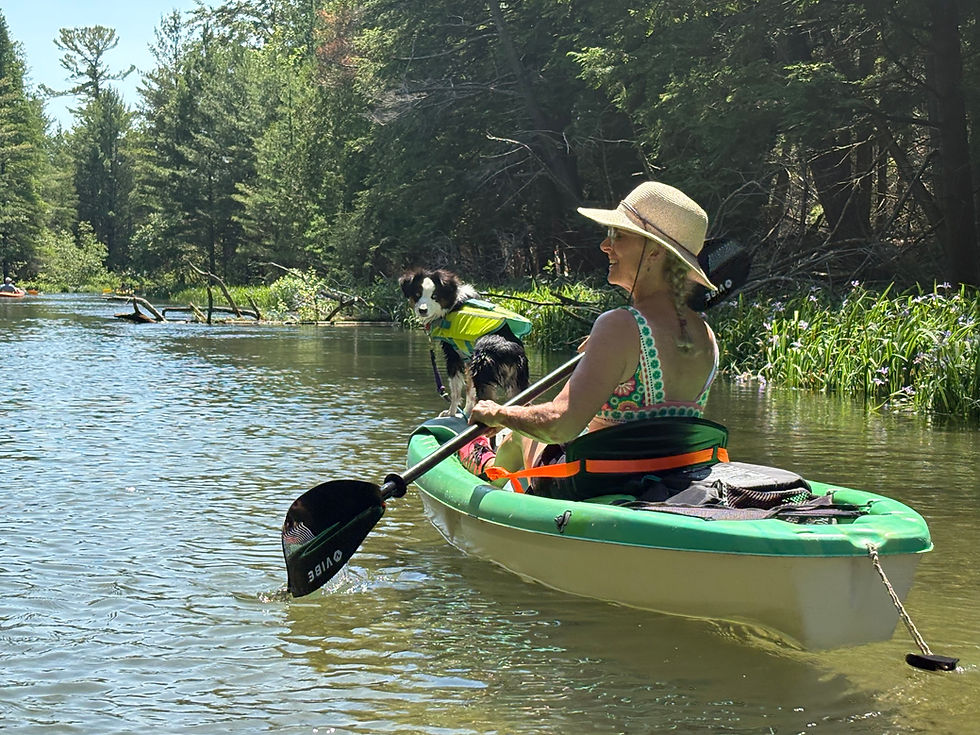
At Sunset Hill, we are big fans of raising dogs who can truly do life with their families.
Not just look cute in the backyard. Not just survive a walk around the block. But really join in on the fun — whether that means tagging along to the creek, hiking a trail near the waterfall, riding in the canoe, or balancing on a paddle board like they were born for it.
Now, to be clear, most puppies are not naturally born as polished little river guides.
They are born as puppies.
Which means they are wiggly, curious, occasionally dramatic, and often convinced that standing on anything slightly weird is a deeply questionable life choice.
The good news? This is trainable.
If your dream is to have a dog who can confidently enjoy kayaking, canoeing, paddle boarding, or other water adventures with you, the key is not to rush into the water. The key is to build the foundation first.
Here is your step-by-step guide to training your dog or puppy for a kayak, canoe, or paddle board — starting on dry land, where confidence is built best.
What you will find in step-by-step detail below:
Build body awareness with indoor balance work
Introduce the life preserver at home
Start early with water exposure in creeks, rivers, and nature settings
Bring the kayak, canoe, or paddle board home to practice
Teach calm getting on and off
Practice sitting, lying down, and settling on the boat
Add gentle movement on dry land
Strengthen practical obedience cues
Rehearse the full routine outside
Start with calm water and very short outings
Why Early Preparation Matters for Water Adventure Dogs
If you want a dog who can relax on a kayak, settle in a canoe, or ride a paddle board without turning the whole experience into a floating circus act, preparation matters.
A lot.
Your dog needs more than bravery. They need:
body awareness
balance
confidence on odd surfaces
comfort wearing a life preserver
familiarity with water sounds and outdoor environments
practice getting on, off, and settling calmly
That is why the smartest way to train for water adventures is to start long before your dog ever touches open water.

How to Train Your Puppy for a Kayak, Canoe, or Paddle Board
Step 1: Start With Indoor Balance and Body Awareness Training
Before a puppy can feel confident on a kayak, canoe, or paddle board, it helps if they learn that strange surfaces are not, in fact, a personal attack.
This is where indoor balance training comes in.
Teaching your puppy to move over shifting, uneven, or slightly wobbly surfaces helps build body awareness and confidence. It also helps them learn to slow down, think through movement, and trust themselves.
Indoor balance training ideas for puppies and dogs
Wobble boards. A wobble board is a great way to introduce gentle movement under your puppy’s feet. Start by rewarding any interest in the board, then work up to one paw, two paws, and eventually standing calmly.
Balance boards. These are wonderful for teaching your puppy to stabilize themselves and stay relaxed when the surface moves a bit.
Couch cushions or floor pillows. Not fancy, but effective. Let your puppy carefully walk across uneven soft surfaces to build coordination.
Low platforms or place boards. Practice stepping up, turning around, sitting, and lying down on a defined surface.
Kick board floating in the bathtub. Yes, really. A kickboard or similar floating object in the bathtub can be a great beginner step. Start with no water or just a tiny bit so your puppy gets used to the sensation of a slightly moving surface in a very controlled environment.
What to practice during balance sessions
Keep it simple:
stepping on
standing still
sitting
laying down
stepping off calmly
staying relaxed when the surface shifts
Short sessions are best. A few minutes at a time is plenty.
The goal here is not perfection. The goal is to help your puppy think, Huh. Weird surface. I can handle a weird surface.
A very useful life skill, honestly.

Step 2: Teach Your Puppy to Be Comfortable in a Life Preserver
If your dog will be around deep water, moving water, or any boating activity, a properly fitted canine life jacket is a must.
And just like with anything else, do not wait until the big adventure day to introduce it.
Because if the first time your puppy wears a life preserver is at the lake, with wind, splashing, people, gear, and excitement all happening at once... well, that is one way to create opinions.
Strong opinions.
How to introduce a dog life jacket
Start at home:
Let your puppy sniff the life jacket.
Reward curiosity.
Put it on for a few seconds.
Remove it before your puppy gets bothered.
Repeat in short, positive sessions.
Slowly build up how long they wear it.
Once they are comfortable wearing it, have them:
walk around the house
practice sits and downs
do simple balance work
settle on a mat
get treats and praise while wearing it
You want the life jacket to feel normal, not like a betrayal.

Step 3: Start Early With Water Exposure in All Forms
A puppy does not need to be in the water to start learning about it.
In fact, some of the best early exposure has very little to do with actual swimming and everything to do with familiarity.
Dogs who are exposed early to the sounds, movement, and feel of water-rich environments often handle future adventures with much more confidence.
Great early water exposure ideas
Take your puppy to experience:
creeks
rivers
ponds
trails near waterfalls
wooded paths with moving water nearby
shallow shoreline edges
damp rocks and muddy paths
areas where they can hear rushing water from a comfortable distance
This helps your dog become familiar with:
splashing sounds
moving water
slippery or uneven terrain
wind through trees
birds, insects, and all the normal sounds of outdoor adventure
Let your puppy observe, sniff, and take it in without pressure.
That part matters.
We are not aiming for “fearless at all costs.” We are aiming for calm curiosity. There is a difference, and it matters a lot.
Step 4: Bring the Kayak, Canoe, or Paddle Board Home
One of the easiest and smartest training tricks is this:
Put the boat in your living room, garage, or backyard.
Seriously.
If your puppy only sees the kayak for the first time at the lake, it is suddenly a giant weird object in a stimulating environment. But if your puppy has already spent two weeks climbing on and off it in the backyard like it is just another Tuesday, that is a whole different story.
Practice with the boat at home
Let your puppy:
sniff it
walk around it
put paws on it
get on and off
sit on it
lay down on it
settle quietly on it
Reward every calm, confident choice.
If your puppy is unsure, break it down into tiny steps:
look at boat
walk toward boat
touch boat
one paw on
two paws on
stand
sit
down
This is the kind of training that looks ridiculously simple and ends up being wildly useful later.
Step 5: Practice Getting On and Off Calmly
A dog who launches themselves like a caffeinated squirrel is not yet ready for boating privileges.
Before you ever hit the water, practice a calm routine for boarding and exiting.
Skills to teach
Useful cues include:
load up = get on
off = get off
wait = pause before moving
place = go to your spot
down = lay down and stay settled
Practice slowly and reward the behavior you want:
stepping on carefully
waiting for permission
staying balanced
exiting without leaping wildly into the unknown
This is especially important for paddle boards and canoes, where one dramatic move can affect the entire setup.
Not ideal.

Step 6: Teach Sitting, Lying Down, and Settling on the Boat
Once your puppy can get on and off confidently, begin practicing the positions you actually want them to hold.
Because “technically on the kayak” and “pleasant to paddle with” are not the same thing.
Practice these key behaviors
Teach your puppy to:
sit calmly on the kayak, canoe, or paddle board
lay down on cue
remain in one designated spot
settle and relax while you move around them
You can even add a towel or non-slip mat to help mark their place.
Start with just a few seconds at a time, then gradually build the duration.
This is one of the most important pieces of training. A dog who can settle is safer, calmer, and much easier to adventure with than a dog who feels the need to supervise every ripple personally.
Step 7: Add Gentle Movement on Dry Land
Once your dog is comfortable on the boat while it is still, begin introducing a little movement.
Very little.
The goal is simply to teach your puppy that shifting underneath them is not cause for emotional collapse.
How to practice movement
While the kayak, canoe, or board is safely on land:
gently rock it
shift it slightly
reward your puppy for staying relaxed
ask for a sit or down
keep sessions short and easy
If your puppy startles, stiffens, or jumps off, that is your sign to go slower.
Confidence grows best when the dog feels successful, not overwhelmed.
Step 8: Pair Water Adventure Prep With Basic Obedience
You do not need a competition obedience dog to enjoy kayaking with your pup.
But you do need some practical skills.
Helpful cues for kayaking, canoeing, or paddle boarding with a dog
Your dog should have a decent understanding of:
name recognition
recall
sit
down
stay
leave it
wait
load up
off
settle/place
These cues help with real-life moments like:
waiting before boarding
not jumping out too soon
ignoring distractions
laying down when excitement starts climbing
staying put while you get organized
In other words, they help turn chaos into cooperation, which is a lovely thing.

Step 9: Do a Full Dry Run Outside- Or if you're feeling confident, skip to step 10 ;)
Before the first real water session, practice the whole routine outside on land.
This helps your puppy connect all the pieces together.
Rehearse the full sequence
put on life jacket
walk calmly to the boat
wait before boarding
get on cue
sit or lay down
settle in position
get off calmly
Do this in the yard, driveway, or anywhere safe and quiet.
This step is often overlooked, but it is incredibly helpful. It bridges the gap between indoor practice and the real outing.
Step 10: Start With Calm, Easy Water
When it is finally time for the real thing, choose your first water session wisely.
This is not the day for rough current, a busy launch, choppy water, or a crowd of screaming children flinging pool noodles.
Choose:
calm water
easy entry and exit
a quiet environment
a short outing
little wind
minimal distractions
Stay close to shore and keep the session brief.
A few good minutes is a win.
Actually, for a first outing, a few good minutes is a great win.
End early while your puppy is still calm and successful. That is how you build a dog who thinks water adventures are fun, not overwhelming.

blue merle mini aussie learning to balance on paddle board 
blue merle mini aussie learning to balance on paddle board 
blue merle mini aussie learning to balance on paddle board
Pool Practice is a Great Beginning too!
Check out "baby" Stevie Beans & Sid learning water and kayaking/paddleboarding confidence in the backyard pool.
Safety Tips for Dogs on Kayaks, Canoes, and Paddle Boards
(because you know I have to give my little blurb about safety)
Any time you are training around water, safety comes first.
A few important reminders:
always use a properly fitted canine life jacket
never force your puppy into water or onto equipment
avoid strong currents or rough water with beginners
use non-slip surfaces when possible
supervise closely at all times
keep first sessions short
remember that confidence builds in layers
Also, not every dog will love every type of water activity, and that is okay.
Some dogs will adore a canoe and hate a paddle board. Some will love hiking by the creek and think the kayak is nonsense. They are allowed to have preferences.
Rude, perhaps. But allowed. (wink)
.
.
.

