Leave It, Made Easy: Tiny Training Moments at Mealtime

True Story from Jill- envision it: me running across my backyard, screaming at my dog, flip flops falling off mid run, and me making loud noises accompanying my yelling "EWWW YuK! LEAVE IT! DROP IT!!! <<ugghhhhhh >>NOOOOO DROP IT, CASSIE LEAVE IT!!!! NOOOOOOOO! << gag>> BAD GIRL..... <<deep slow motion sigh>> as she snarfs the giant pile of cat poop in my garden. Needless to say, my words meant NOTHING in that moment. And, truth be told, we could repeat this story and insert the name, Hoola (our pitty rescue), as she snarfed a whole stick of butter off my kitchen island. Ya.... been there.

So, if you’ve ever said “LEAVE IT” while your puppy proudly trots away with a sock (or a mystery leaf, or—somehow—your sanity), you’re not alone.
“Leave it” is one of the most useful real-life skills you’ll ever teach your Aussie. It’s also one of the most frustrating… until you stop trying to train it like a big formal lesson and start training it like a tiny daily habit.
Because here’s the truth: Tiny habits are so small they slip past your brain’s resistance—making them easy to start, easy to keep, and powerful for building momentum.
That’s exactly the energy we want for “leave it.” and a free will choice to NOT snarff all things on the ground.
Here's 16-week-old Nugget. No AI-generated business here. These are REAL LIFE PHOTOS. Me, Nugget, and my iPhone 16 propped up against a mason jar. Hahaha!!! Nugget willfully chooses to leave chips, eggs, and meds behind. This is so very important. You may or may not be a mom of special needs kiddos like me, and have to deal with things like seizure meds for your human kids. But you still want to keep your puppy safe. It is possible!! Nugget is proof!

teaching leave it to your puppy 
teaching leave it to your puppy 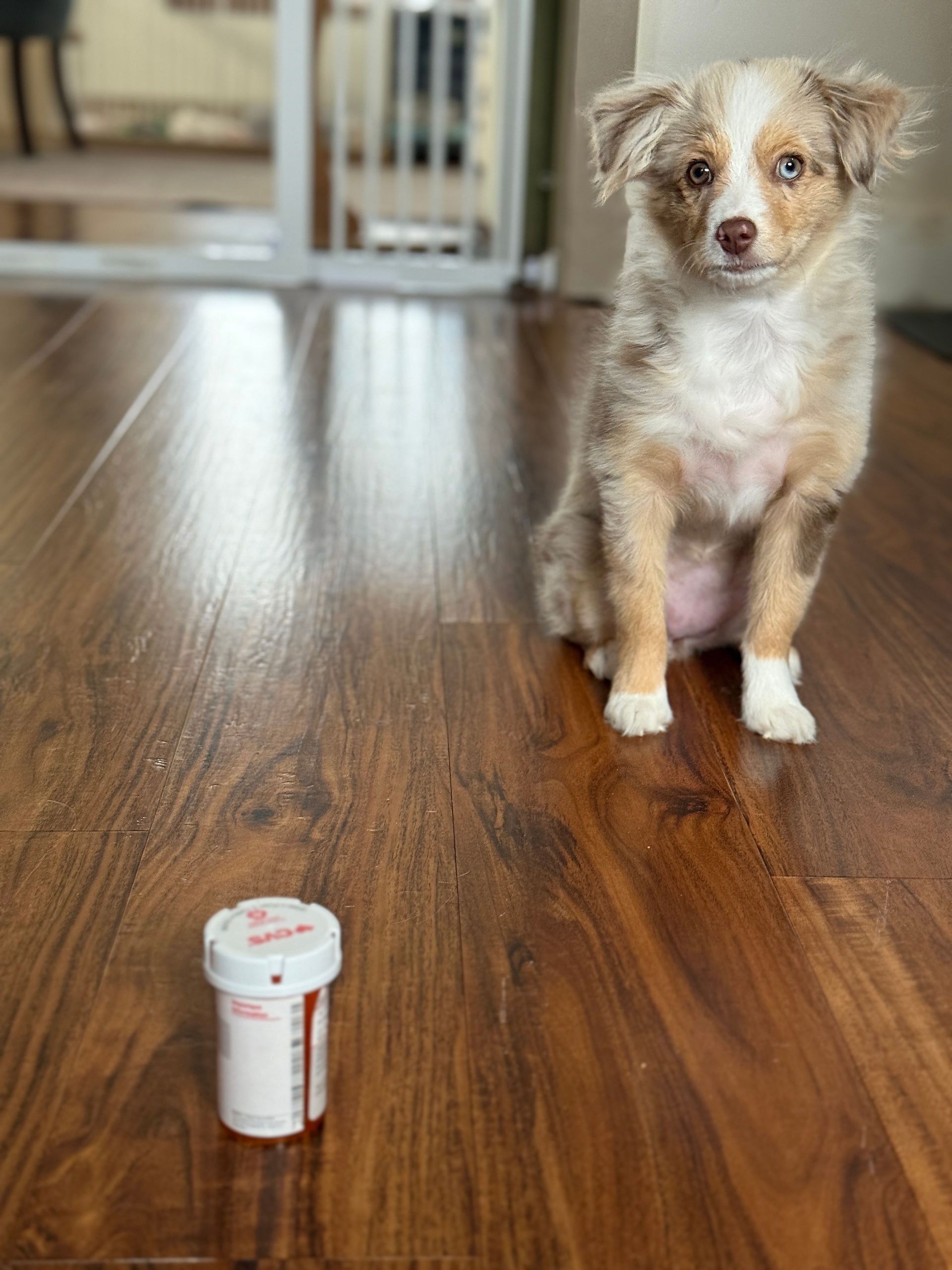
teaching leave it to your puppy
Why “Leave It” Matters (More Than You Think)
“Leave it” isn’t just a command. It’s a life skill:
It keeps your puppy safer (hello: chicken bones, rocks, random sidewalk snacks)
It builds impulse control (which affects everything from jumping to leash manners)
It teaches your puppy: good choices get rewarded
And for Aussies—smart, fast, and always “working on something”—that last part is huge.
The Problem With How Most People Train “Leave It”
Most people try to teach “leave it” only when something is already happening:
Puppy grabs the shoe → you panic → you repeat “leave it” 7 times → puppy… does not leave it
That’s not your fault. That’s just not a fair learning setup.
Instead, we want to train “leave it” when:
you’re calm,
your puppy can win,
and you can repeat it daily.
The Tiny Training Moments Method
We’re going to use Tiny Training Moments and a simple idea called habit stacking.
Habit stacking means: attach a new habit to something you already do every day.
You already feed your puppy. So we’ll stack training onto meals.
Your new habit:
Add 5 minutes to your puppy’s meals each day.
Not after work.
Not “when things calm down.”
Not “when I have time.”
Just: meals.
It’s practical, doable, and it turns training into a rhythm—like brushing teeth.
Tiny, consistent, automatic.
You can totally do this!
This 5 min routine at first might consist of 5 min at step 1 on the first day. Then, on day 2, you can do steps 1 & 2, and so on. Progress until you can do all 5 on the same day within a few minutes span. If you do this daily, you will be shocked at how fast your dog learns.

Step 1: Closed Fist
Put a piece of kibble in your closed fist.
Let your puppy sniff/lick. Keep your hand super still.
DO NOT TALK (listen, I know it's tempting to say "ehh" or "no" but if I, a talk-a-holic, can do it, so can you ;)
The moment they pause or look away or back up, mark it with ONE word (“yes!”) and reward with a treat by delivering it directly to them.
Goal: Your puppy learns that backing off makes treats happen.
Step 2: Open Palm
Put the kibble on your open palm.
If they dive for it, close your hand gently.
When they back off, mark and reward.
Goal: They learn self-control, not “snatch it fast.”
Step 3: Floor by your feet
Place a piece of kibble on the floor by your feet. You can cover it lightly with your foot or bend over and make a gentle hand "tent".
Wait.
The second your puppy stops trying to get it, mark and reward from your hand.
Goal: They practice leaving something alone even when it’s “right there.”


Step 4: Real-Life Item (Easy Mode)
Pick something safe and boring-ish (a toy, a napkin, a low-stakes item).
Put it nearby.
Reward your puppy for choosing you instead of the object.
Goal: “Leave it” becomes a choice, not a battle.
Step 4+: Real-Life Item (Challenge Mode)- for those of you who love to push boundaries- lol
Pick something familiar in your house- I chose chips as my teens are constantly eating them.
Put it on the table, enlist a "helper".
Have your helper knock chips onto the floor.
Reward your puppy for choosing you instead of the object.
Goal: “Leave it” becomes a choice, not a battle.

teaching leave it to your puppy 
teaching leave it to your puppy 
teaching leave it to your puppy
Step 5: Add the Cue
Only add the words after your puppy is already succeeding.
As they back off, calmly say: “Leave it.”
Reward immediately.
Goal: The cue starts to mean, “Back off and you’ll get paid.”
Do you learn best by watching?
Check out my video of Nugget doing this.
What to Do When Your Puppy Messes Up
They will. Puppies are puppy-ing.
Here’s the rule: If your puppy can’t win, make it easier.
Use lower-value distractions
Increase distance
Go back to closed fist
Reward faster (don’t wait for perfection)
This should feel doable—not like a daily wrestling match.
The Secret Sauce: Momentum
This is why we do it this way. When you stack 5 minutes onto meals, you:
stop relying on motivation
build a repeatable routine
get progress you can actually keep
And that’s how training sticks.
Tiny habits are so small they slip past your brain’s resistance—making them easy to start, easy to keep, and powerful for building momentum.
“Leave it” becomes something your puppy practices like clockwork, not something you only remember when they’re sprinting away with contraband.
When You’ll Know It’s Working
Look for these small wins:
Your puppy pauses when they see something tempting
They look at you for direction
They disengage faster
You say “leave it” once—and it actually means something
Those are foundation-building moments. Celebrate them.
A Personal Note (Because You Need This)
If you’re reading this thinking, I’m behind, I want to call that out gently:
You’re not behind. You’re building.
Behind is a state of mind (well, most of the time).
Or if you are thinking, I missed the boat, my dog is too old, yet again I will say- nope.
Old dogs can still learn new tricks, too. ,
Puppy training isn’t about being perfect. It’s about stacking tiny wins until they become automatic. That’s how confident puppies—and confident owners—are made.
Just give it a shot, keep this routine for one week, and watch how quickly your puppy starts offering that little pause. That pause is your doorway into calmer, safer, more responsive behavior.
And yes… eventually your socks may survive. 😉


