How to Stop Your Aussie From Herding Your Kids


Your Aussie is not trying to be naughty when they chase your running kids.
But if that little “herding game” is allowed to continue, the next step is usually puppy nipping, heel grabbing, torn pant legs, and a whole lot of family frustration.
Australian Shepherds, Mini Aussies, and Mini American Shepherds were bred to notice movement.
Fast movement. Loud movement. Unpredictable movement.
You know—tiny humans running across the yard like loose livestock with popsicles.
So when your kids start running, squealing, biking, wrestling, or playing tag, your
Aussie’s busy little brain may say:
“Oh good. A job.”
The problem is, your children are not sheep.
And while herding may begin as chasing, circling, barking, or cutting the kids off as they run, it can quickly turn into nipping at heels, grabbing clothing, knocking children over, or creating a game that no one is enjoying anymore.
The good news is that you do not have to train the herding instinct out of your Aussie.
You need to teach your Aussie self-control around movement.
That is the real goal.

lyla learning to settle around kids 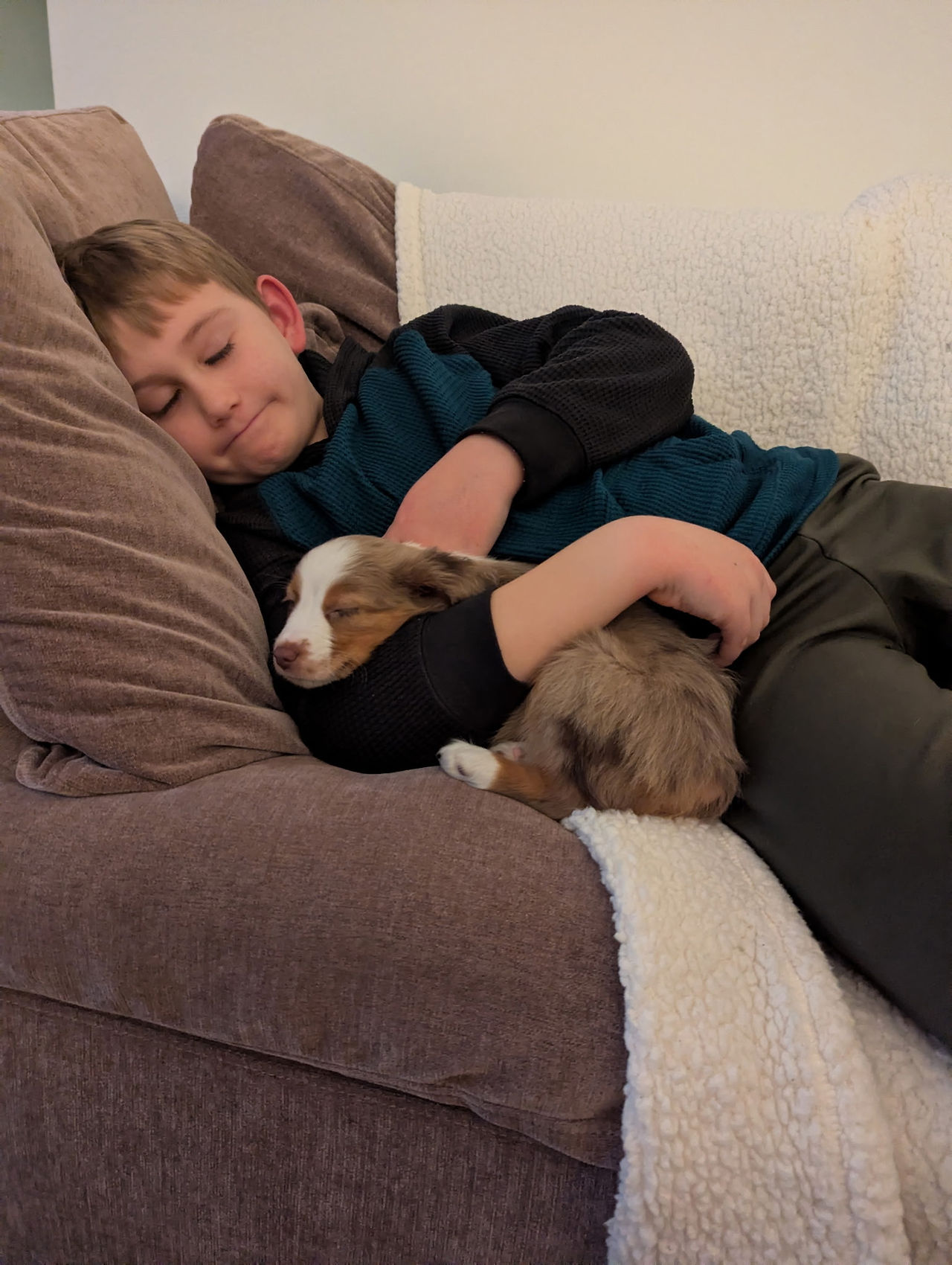
puppy snuggles w kids 
archie learning to snuggle kids
Why Does My Aussie Herd My Kids?
Aussies are smart, observant, movement-sensitive dogs. That is part of what makes them so fun, loyal, and trainable.
But without structure, that same brilliant Aussie brain can become a little too invested in managing the entire household.
Your Aussie may herd your children because:
The kids are running.
The kids are squealing.
The kids are unpredictable.
Your Aussie is overstimulated.
Your Aussie has not learned what to do instead.
Chasing has become a really fun habit.
Once a dog practices a behavior repeatedly, that behavior becomes easier and more automatic.
Every time your Aussie chases, circles, barks, or nips while the kids run, they are getting better at doing exactly that.
Not exactly the skill we were hoping to build.
This is why I like to approach the problem with a simple two-part plan:
Preventative training: Stop your Aussie from practicing the unwanted behavior.
Prescriptive training: Teach your Aussie what to do instead.
We need both.
Management without training never teaches the dog a new skill. But training without management allows the dog to keep practicing the exact behavior we are trying to change.
Let’s start with learning "the thing before the thing".
~Susan Garret
Part One: Preventative Training
The thing before the thing is simply that. Figuring out what THING happened BEFORE the negative behavior occurred.
Preventative training is about setting your Aussie up to succeed before they are already in full herding mode.
Because once your Aussie is crouched low, pupils huge, body tense, and laser-focused on your child’s ankles, that is not the ideal moment to begin calmly explaining life choices.
We want to step in before they are all gas, no brakes.
Prevention matters.
1. Stop Letting Your Aussie Practice Herding
If I had a dime for every time a family called or texted me about "Jill, how can I get the puppy to stop nipping my kids?" my pockets would be overflowing. LOL. This is the part people do not always love hearing, but it matters:
What should NOT happen:
Your Aussie has unlimited freedom around running children.
Your kids are "tiring out" the puppy by playing chase.
Zoomies are a source of fun and entertainment for the humans, "Oh. It's so cute"
Your kids are having fun playtime at the same time as the puppy.
Allowing your kids to be playmates to the puppy instead of being a leader.
That may mean using:
A leash
A long line
A baby gate
A crate
A place cot
A fenced-off area
Supervised yard time
This is not punishment.
It is management.
Management prevents your Aussie from rehearsing the unwanted behavior while you build the skill you actually want.
Think of it this way: You would not hand a toddler a permanent marker in a freshly painted white room and say, “Now make good choices.”
Same concept.
If your puppy has not yet learned how to handle full-throttle kid activity, do not keep placing them in the middle of it and hoping today will somehow be different.
Set them up to win.
2. Give Your Aussie a Job Before the Kids Start Running
A bored or under-engaged Aussie is very likely to create their own job.
And sometimes that job is:
Assistant Manager of Children’s Movement.
Before your kids go outside to run, bike, wrestle, or play, give your Aussie something structured to do first.
Try:
A short training session
A sniff walk
Food scattered in the grass
A frozen lick mat
A safe chew
A “find it” game
A few minutes of leash work
Calm time on place
Quiet crate time with a chew
This does not mean you need to exhaust your dog.
In fact, wildly exercising an already overstimulated Aussie often creates a stronger athlete—not a calmer dog.
You may end up with the exact same wild child, except now they have better cardio.
The goal is not simply to make your Aussie tired.
The goal is to help their brain become mentally settled.
Aussies do not always need more movement. Sometimes they need help learning how to stop moving.

3. Teach a Solid “Place” Command
One of the most valuable skills for an Aussie who wants to herd children is a reliable place command.
Place teaches your dog:
“Movement is happening, but you do not need to manage it.”
Start easy.
Have your Aussie lie on a cot, mat, or dog bed while one child calmly walks nearby. Reward your dog for staying settled.
Then gradually increase the challenge:
A child walking
A child skipping
A child jogging
A child tossing a ball
A child running a short distance
Multiple children playing normally
Do not jump straight from “one child quietly exists” to “three kids playing tag like caffeinated squirrels.”
Build the skill in layers.
This is where the thing before the thing matters. Teach the skill when the environment is calm enough for your Aussie to think.
Then slowly make the environment more challenging.
4. Reward Calm Choices Around Movement
Many Aussies are corrected when they chase, but they are never rewarded when they make a good choice.
That is a huge missed opportunity. Trust me, I know!! I totally did this wrong with my first Aussies (as well as a bunch of our rescues).
When your Aussie watches the children run and chooses not to chase, reward that.
When your Aussie looks at you instead of locking onto the kids, reward that.
When your Aussie relaxes while a bike rolls past, reward that.
When your Aussie notices movement and then disengages on their own, absolutely reward that.
You are teaching:
“Running kids are not your cue to chase. Running kids are your cue to check in with me.”
That is a major mindset shift.
Remember, calm behavior is still behavior.
It deserves to be noticed and reinforced.
5. Teach the Kids the Rules Too
This part matters.
Children can accidentally make herding behavior much more exciting.
Teach your kids:
TAKE TURNS running around. If the puppy is running, the kid is sitting. If the kids are running around, the puppy is in a pen or crate.
Do not scream and run away from the puppy.
Do not tease the dog with wild movement.
Do not flap toys near the dog’s face, it's not funny.
Do not encourage the dog to chase.
If the dog gets too excited, freeze like a tree.
Call an adult instead of running faster.
I can hear some of you now saying. "Jeepers, Jill, you are totally the fun police! Can we just let kids be kids?" Well, you can. That is your choice. But then don't be frustrated with your dog for nipping your kids. It's just a choice. You have to choose what you want most.
Running faster usually convinces the Aussie that the livestock is escaping.
Again, not ideal.
This is not about blaming the children. Kids are kids.
But puppies and children both need structure, boundaries, and supervision.
We cannot expect the puppy to make excellent choices while the children are accidentally turning the entire backyard into a herding trial.
Part Two: Prescriptive Training
Preventative training keeps the unwanted habit from becoming stronger.
Prescriptive training teaches your Aussie what to do instead.
Because “Do not herd the children” is not very useful information to a dog.
We need to teach clear replacement behaviors:
When the kids move, come back to me.
When the kids run, go to place.
When the kids play, stay beside me.
When you feel excited, choose self-control.
When life gets big, settle your body.
Your Aussie does not need a cheerleader winding them up.
They need a CALMleader, not a cheerleader, showing them what to do next.
Step 1: Interrupt the Behavior Early
Do not wait until your Aussie is already nipping.
Watch for the early signs:
Staring
Crouching
Stalking
Circling
Barking
Cutting in front of a child
Chasing feet
Fixating on movement
The earlier you interrupt the pattern, the easier it will be to redirect your dog.
Use a cheerful, familiar cue such as:
“This way!”
“Come!”
“Let’s go!”
“With me!”
“Place!”
Try not to rely on yelling “NO!” from across the yard. (This one was hard for me to learn! But I kept talking to myself-- Jill, you can do hard things LOL- zip the lip!!)
That may interrupt the behavior for half a second, but it does not teach your Aussie what to do instead.
We do not just want to stop the wrong answer.
We want to help them practice the right one.
Step 2: Redirect Your Aussie Back to You
When your Aussie begins locking onto the kids, call them back to you.
Reward generously when they turn away from the movement.
This is a big deal.
You are asking a herding breed to disengage from what may be the most exciting thing happening in the entire yard.
Pay them well.
Use food, praise, movement with you, a favorite toy, or whatever safely motivates your dog.
You want your Aussie to learn:
“Leaving the kids alone is worth it.”
Over time, your dog should begin looking to you automatically when the children start moving.
That is the connection we want to build.

Step 3: Practice With Controlled Movement
Do not practice this skill only when your kids are already running full speed through the backyard.
Set up short, controlled training sessions.
For example:
Put your Aussie on a leash beside you.
Ask one child to walk slowly across the yard.
Reward your Aussie for remaining calm.
Ask the child to walk a little faster.
Reward calm again.
Have the child jog a short distance.
Reward your Aussie for checking in with you, staying beside you, or holding place.
You are gradually teaching your dog that movement does not automatically mean chase.
Keep the sessions short.
Five good minutes is better than twenty minutes of everyone losing their minds.
Just practice 5 min after each meal! Tiny Training Moments are a game changer.
Stop while your Aussie is still successful.
You can always practice again later.

Step 4: Use “Place” as a Reset
If your Aussie starts becoming too excited:
Send them to place or calmly guide them there on leash.
Let them settle.
Reward calm behavior.
This is not a dramatic time-out where your dog is expected to sit and think about what they have done.
It is a reset.
Your Aussie’s brain is learning:
“When I get too excited, I know how to come back down.”
That skill is gold for an Aussie.
We are not trying to squash their personality or remove their joy.
We are teaching them how to move between excitement and calm without getting stuck in over-the-top mode.
Step 5: Remove Access When Needed
If your Aussie continues chasing, barking, or nipping, calmly remove them from the situation.
No yelling.
No emotional lecture.
No chasing the dog around the yard while everyone becomes increasingly frustrated.
Simply say:
“Okay, you are not ready for this level yet.”
Then use the leash, gate, crate, or place command.
People sometimes feel guilty about removing the dog, but honestly, this is kind.
I absolve you of all guilt!! Your future self will thank you!
Allowing your Aussie to rehearse nipping is not kind to the dog or the children.
Clear boundaries help everyone feel safe.
Step 6: Build Freedom Back Slowly
Once your Aussie is doing well on leash, do not immediately give them full freedom during wild kid play.
Progress gradually:
On leash near calm movement
On leash near faster movement
On a long line during play
Short off-leash periods with close supervision
More freedom as your Aussie consistently shows self-control
Freedom should be earned through self-control—not gifted during peak nonsense.
Your dog may do beautifully one day and struggle the next.
That is normal.
Excitement level, sleep, environment, age, and the intensity of the children’s play can all affect your Aussie’s ability to make good choices.
Simply adjust the level and keep practicing.

Calm behavior is rewarded 
Ruby Roo and her kiddos 
Sable snuggle time
What Not to Do When Your Aussie Herds Your Kids
A few common reactions can make the behavior worse.
Avoid:
Letting the children run away screaming
Laughing while the puppy chases them
Allowing “playful” heel nipping
Waiting until the dog is fully overstimulated before stepping in
Correcting without teaching a replacement behavior
Giving the dog too much freedom too soon
Assuming the puppy will simply grow out of it
Some puppies do naturally become calmer with age.
But many Aussies simply become faster, stronger, and more committed to the game.
Training now is much easier than changing a deeply practiced habit later.
What If My Aussie Is Already Nipping My Kids?
If your Aussie is already nipping, grabbing clothing, knocking children over, or making your children nervous, take the behavior seriously.
That does not mean your dog is bad.
It means the behavior needs structure immediately.
Go back to the basics:
Use a leash or long line around children.
Stop unsupervised play.
Practice place training.
Create calm exposure to movement.
Reward your dog for disengaging.
Use short, successful training sessions.
Remove your Aussie when they begin escalating.
If the nipping is intense, persistent, or frightening, work with a qualified trainer who understands herding breeds, positive reinforcement training, and family life.
You are not failing by getting help.
You are being responsible.
The Real Goal: An Aussie Who Can Handle Family Life
Your Aussie does not need to become a couch potato.
That is not realistic for most Aussies, and honestly, it is probably not why you fell in love with the breed.
The goal is not to erase their personality.
The goal is to teach them how to live with self-control.
A well-trained Aussie can watch children run, bikes roll past, balls bounce, doors open, and everyday family life happen without feeling responsible for controlling every moving object.
But that ability does not appear by accident.
It develops through structure, repetition, calm leadership, and rewarding the behavior you actually want.
So remember:
Your children are not sheep.
Your Aussie does not need to manage recess.
Your busy-brained, all-gas-no-brakes movement manager can learn to make better choices.
And yes, this is absolutely figure-out-able.

Simple Recap you can put on a sticky note as a reminder
To stop your Aussie from herding your children:
Teach kids to be CALMleaders, not cheerleaders.
Use leashes, gates, crates, place, and supervision.
5 min, 3x/day- teach calm behavior around movement in small steps.
Reward your Aussie for checking in with you.
Give them a clear replacement behavior.
Interrupt the pattern before they are fully overstimulated.
Build freedom slowly as they demonstrate self-control.
Aussies are smart.
They can learn ANYTHING.
But with consistency and a calm plan, your wild little movement manager can learn that running children are not a job.
They are simply family.

.
.

