15 Questions to Ask a Mini Aussie Breeder Before Adopting a Puppy


How to Look Beyond the Pretty Puppy Photos and Find a Breeder You Can Trust
I was once in your shoes. I was shocked at how many "registered breeders" would not let me visit their property or were super vague about puppies' daily life, testing, and vet visits.
A personal word of caution: Before you begin scrolling through photos, imagine names and picture that tiny puppy asleep on your couch. Then you see the blue eyes, fluffy coat, and adorable head tilt—and suddenly your heart has made a decision before your brain has finished asking questions. Stop yourself, grab a pen & paper or the notes app on your phone, and write down these questions below to help you guard your future with your new puppy.
Choosing a Mini Aussie breeder is about much more than finding an available puppy in your favorite color.
You are choosing the person who selected your puppy’s parents, made decisions about genetic health, cared for the mother during pregnancy, and raised your puppy through some of the most important developmental weeks of their life.
A responsible breeder should not become uncomfortable when you ask thoughtful questions. They should appreciate that you care enough to ask them.
You are not trying to catch a breeder doing something wrong. You are simply looking for evidence that their words match the everyday reality of how their dogs and puppies live.
Here are the most important questions to ask a Mini Aussie breeder before placing a deposit or choosing your puppy.
Questions to Ask a Mini Aussie Breeder at a Glance
Can I visit your property?
Can I meet the mother and your other adult dogs?
What does daily life look like for your mama dogs?
Why did you choose this particular pairing?
What health and genetic testing have both parents completed?
Can I see the actual test results?
How do you handle merle genetics?
What does a normal day look like for this litter?
What exactly do you include in early socialization?
Who works with the puppies every day?
How are puppies matched with their families?
Is the Breeder Properly Licensed and Following Their State’s Requirements?
What veterinary care do the puppies receive?
What does your contract and health guarantee cover?
What support will I receive after bringing my puppy home?
If that list above is enough for you, no need to read on; just write them somewhere so you can use them.
But if you are like me, and love some details and explanation, keep reading, and I'll flesh out each one a bit more.

1. Can I Visit Your Property?
This should be one of your first questions.
You deserve to see where the breeder’s dogs live, where the puppies are raised, and how the dogs interact with the people caring for them. I was shocked by how many breeders wouldn't let me visit them, even as a fellow breeder. And some even refused FaceTime as an alternative. RED FLAG!!!!
A responsible breeder may have reasonable rules for visits. They may ask you to schedule an appointment, wear clean shoes, wash your hands, leave other pets at home, or wait until the puppies have reached an appropriate age.
Those are sensible precautions.
However, "biosecurity" should not erase transparency altogether.
Another red flag: “No one is ever allowed on our property because of biosecurity” should automatically end the conversation.
Biosecurity should not become a convenient blanket excuse that prevents every family from ever seeing the breeder’s property, adult dogs or living conditions.
Newborn puppies do not need a parade of strangers walking through their whelping room. That does not mean serious families should be permanently kept at a distance or required to meet in a parking lot.
The American Kennel Club recommends visiting the breeder’s home or kennel, observing the premises and meeting at least one of the puppy’s parents.
During a visit, notice:
Are the dogs clean, healthy and comfortable?
Do the dogs appear relaxed around the breeder?
Are the living areas reasonably clean?
Do the dogs have room to move, play and rest?
Are adult dogs part of the breeder’s life?
Does the property match what is shown online?
Is the breeder comfortable letting you see normal daily life?
A polished website and beautiful puppy photos cannot tell you everything. Seeing the environment gives you a much clearer picture.


2. Can I Meet the Mother and Your Other Adult Dogs?
The answer should always be Yes, of course!
The mother of the litter can tell you quite a bit about the puppies’ possible temperament, structure, and appearance.
She may be tired, protective, or less social while caring for young puppies, so do not expect her to perform for you. However, the breeder should be able to explain her normal personality and allow you to see her when appropriate.
The father may live with another breeder or belong to an outside program. That is not unusual. When the father is not on the property, ask for photos, videos, health information and an honest description of his temperament.
Also pay attention to the breeder’s other adult dogs.
Do they seem comfortable around people?
Can they settle?
Do they appear physically healthy?
Are they constantly barking, pacing or acting overwhelmed?
Does the breeder know each dog as an individual?
No breeding program produces identical puppies, but the adult dogs can offer a glimpse into the traits the breeder is building into future generations.
3. What Does Daily Life Look Like for Your Mama Dogs?
This is different from asking where the puppies are raised.
Ask about the mothers when they are not raising puppies.
Try asking:
Where does she sleep at night?
Does she live in the house?
What does a normal day look like for her?
Does she go on walks, run outside or spend time with the family?
How often is she bred?
How much recovery time does she receive between litters?
What veterinary care does she receive before and after pregnancy?
At what age do you retire your females?
What happens to them after retirement?
In other words, ask what an ordinary Tuesday looks like—not only what appears in the litter announcement photos.
A mama dog should have a full life outside of producing puppies. She should be known, loved and cared for as an individual dog.
At Sunset Hill, we strongly believe that dogs get to be dogs here first. Our mothers are family dogs before they are breeding dogs, and that should show in how they live every day.

4. Why Did You Choose This Particular Pairing?
There should be a reason beyond:
“They will make pretty puppies.”
Ask the breeder what they hope the mother and father will contribute to the litter.
A thoughtful breeder should be able to discuss:
Temperament
Confidence
Energy level
Trainability
Structure
Health
Size range
Coat
Strengths within each dog’s pedigree
Traits they are trying to improve
Every dog has strengths and weaknesses. Responsible breeding is not about pretending every parent is flawless. It is about understanding those dogs well enough to avoid doubling up on weaknesses and to make intentional decisions.
Be cautious when the entire explanation revolves around producing tiny puppies, blue eyes, unusual colors or extra-fluffy coats.
Those things may be fun preferences, but they should not be the foundation of a breeding decision.
5. What Health and Genetic Testing Have Both Parents Completed?
Do not settle for:
“They have been vet checked.”
A routine veterinary exam is important, but it is not the same as breed-specific health testing.
Miniature American Shepherd Club of the USA recommendations currently include required screenings for hips, annual ophthalmic eye exams, PRA-prcd, MDR1, HSF4 hereditary cataracts and NAD. MASCUSA also strongly recommends additional evaluations that include elbows, patellas, dentition, CEA, DM, CDDY/CDPA, HUU and CMR1.
Ask the breeder:
Which DNA panel do you use?
Do you test for MDR1?
Has each parent been tested for NAD?
Have their hips been evaluated?
Have they received a current eye examination?
Do you test elbows and patellas?
How do you use carrier results when planning a pairing?
Are the results publicly available through OFA or another database?
A broad genetic panel is valuable, but DNA testing does not replace physical health screenings such as hip radiographs or ophthalmologist eye examinations. Genetic and physical evaluations measure different things, and responsible programs understand the difference.


6. Can I See the Actual Health-Testing Reports?
“Everything is clear” is not documentation.
Ask to see the original reports for both parents. A responsible breeder should be able to provide the registered names of the dogs, testing laboratory, test dates, and results.
You can also search for OFA records yourself.
Health testing cannot promise that a puppy will never develop a medical condition. That is not a realistic guarantee.
Its purpose is to make informed breeding decisions and reduce avoidable risks.
A knowledgeable breeder should be able to explain:
What each test means
Whether a dog is clear, a carrier or affected
Why a particular pairing is considered safe
What health concerns may still appear within the breed
What is known about health and longevity in previous generations
Vague reassurance should never replace actual records.
7. How Do You Handle Merle Genetics?
Merle is one of the beautiful coat patterns seen in Mini Aussies, but it comes with breeding responsibilities.
Ask:
Do you ever breed merle to merle?
Have your merle dogs received M-locus testing?
Do you know whether any dogs carry cryptic or mosaic merle variants?
How do you prevent double-merle puppies?
Can you explain the merle results for this particular pairing?
A dog’s appearance alone may not tell the full genetic story. A dog can LOOK like a tri but ACTUALLY be a Merle!!! This is called Cryptic or Cryptic Plus. Their body looks like a tri color, but their genes are merle. There is absolutely nothing wrong with the dog because of this, but breeders should know these things prior to breeding. When they are tested for their merle gene, they have a number. That Merle Number tells breeders who a dog can and can not breed to based on their merle number.
MASCUSA lists M-locus testing as important for safe breeding practices, and UC Davis notes that breeding two dogs carrying merle variants can produce double-merle puppies that are more prone to serious health problems, such as blindness and deafness.
You do not need to become a canine geneticist before bringing home a puppy. You do need a breeder who understands the genetics behind the colors they are producing.
“We have always done it this way and never had a problem” is not a genetic-testing strategy.


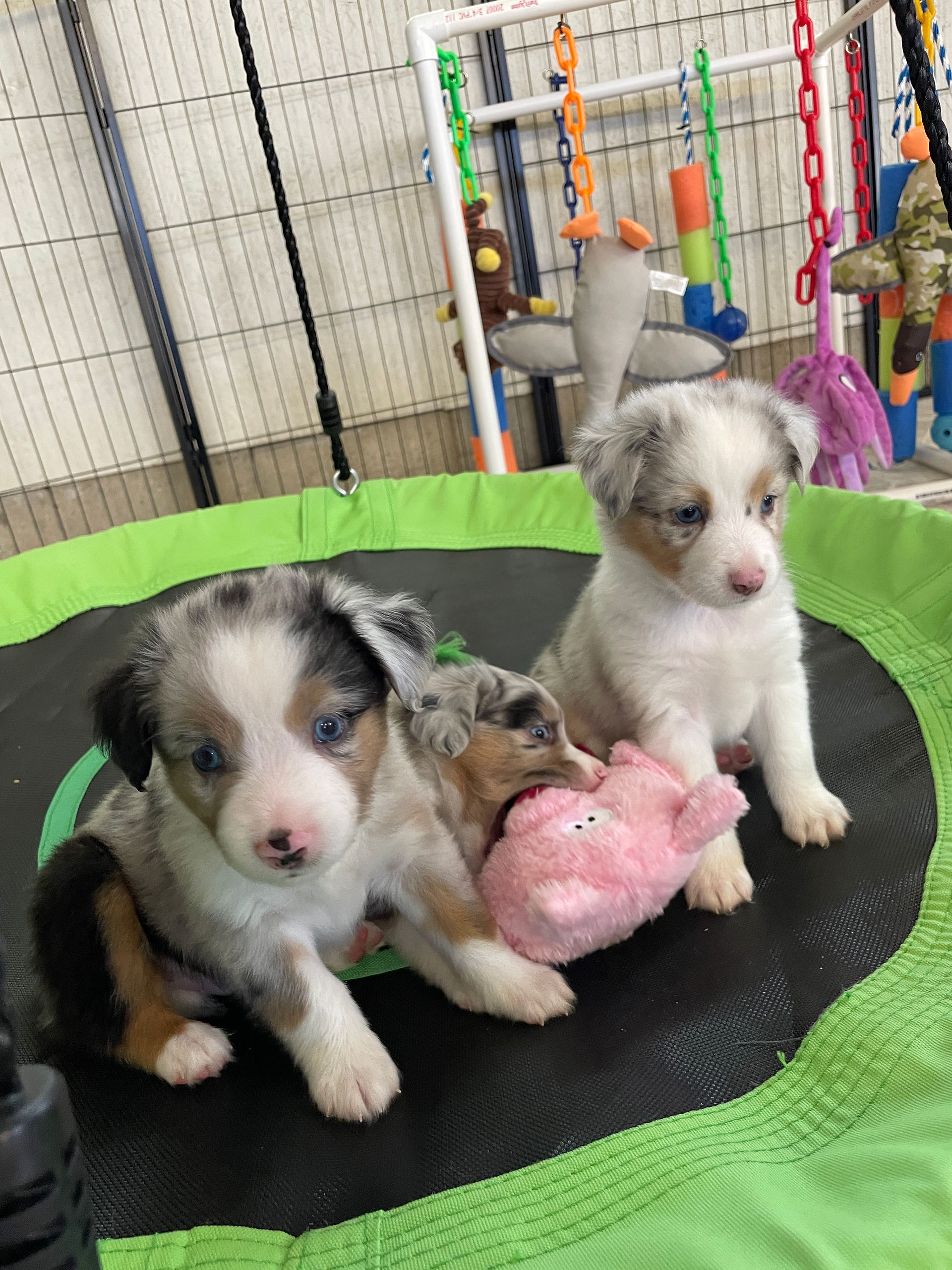
8. What Does a Normal Day Look Like for This Litter?
This may be one of the most revealing questions you ask.
Many websites say:
“Our puppies receive early socialization.”
That sounds nice, but what does it actually mean?
Ask the breeder to walk you through a normal day.
When do the puppies wake up?
Where do they sleep?
How are meals handled?
How often are they taken to a potty area?
Do they spend time indoors and outdoors?
How much individual handling does each puppy receive?
Do they experience structured play as well as quiet time?
Are they learning to settle?
Are they introduced to a crate or puppy pen?
Are they briefly separated from their littermates?
How are nails, brushing and basic grooming introduced?
Do the puppies ride in a vehicle?
What surfaces, sounds and environments do they experience?
Early Neurological Stimulation, a sound playlist or a box of toys can be useful pieces of a puppy-raising program. They are not an entire program.
The breeder should be able to describe what the puppies did yesterday—not only name a branded socialization curriculum.
9. What Exactly Do You Mean by “Socialization”?
Good socialization is not simply exposing puppies to as many things as possible.
It should be thoughtful, age-appropriate, and responsive to each puppy.
Ask whether the puppies experience:
Men, women and children
Different voices and movement
Household sounds
Outdoor sounds
Grass, gravel, concrete, rugs and other textures
Safe climbing and problem-solving activities
Gentle handling of paws, ears and mouths
Grooming tools
Collars and leashes
Crates and pens
Car rides
Calm time around people
Short individual training sessions
New objects without being forced toward them
Mini Aussies are intelligent, observant dogs. Their puppies do not only need more excitement. They also need to practice focus, recovery and calmness.
At SSH, we care just as much about teaching puppies how to come back down as we do about giving them something new to explore.
A puppy does not need to spend eight weeks running around in a constant free-for-all.
Puppies need sleep, predictability, engagement, healthy challenges and opportunities to settle.
The AKC advises families to ask whether puppies have experienced people, other dogs and normal household environments rather than accepting a general claim that they were socialized.

10. Who Actually Works With the Puppies Every Day?
Sometimes the person answering your messages is not the person raising the litter.
Ask:
Who handles the puppies?
How many people are involved?
How much individual attention does each puppy receive?
How many litters are being raised at the same time?
Does the breeder personally know each puppy?
Are employees or helpers trained to follow a consistent routine?
How are observations about each puppy recorded?
Having help is not a red flag. Many good breeders have family members, assistants or trusted puppy helpers. Having help can be a very good thing, if it is GOOD help.
The real question is whether someone knowledgeable is overseeing the program and whether each puppy is being treated as an individual rather than simply one puppy in a large group.
A breeder should be able to tell you which puppy is thoughtful, which one recovers quickly, which one needs a little more encouragement and which one is currently convinced that carrying the food bowl is a full-time job.


11. How Are Puppies Matched With Their Families?
Ask whether puppies are chosen strictly by deposit order or whether temperament and family fit play a meaningful role.
A first-come, first-served picking order may sound fair, but the first puppy chosen is not automatically the best puppy for that family.
Ask:
When do you begin evaluating temperament?
What traits do you observe?
Do you consider energy, confidence and people-focus?
How do you help families understand the differences between puppies?
Will you advise a family against choosing a puppy that is not a good fit?
What happens if there is not an appropriate puppy for us in the litter?
Can our deposit move to a future litter?
How much weight is given to color and eye preference?
At SSH, we believe color can be a preference—but temperament should drive the decision.
The best puppy is not simply the one with your favorite markings. It is the one whose confidence, energy, sensitivity and personality fit the life you actually live.
A good breeder should be willing to say:
“I know that puppy is beautiful, but I do not think they are the best fit for your family.”
That is not a breeder blocking your choice. That is a breeder doing their job.
12. Is the Breeder Properly Licensed and Following Their State’s Requirements?
Dog-breeder licensing laws vary widely from one state to another.
Before choosing a breeder, find out:
Does this breeder need to be licensed in their state?
Are they currently licensed?
Which agency oversees them?
What veterinary care and recordkeeping does that license require?
Is there a public list where you can verify their license?
How often is the breeding property inspected?
Are puppies required to be individually identified or microchipped?
What examinations are required for the mother dogs?
Being licensed does not automatically make someone an excellent breeder.
Licensing requirements are generally the minimum legal standard, not proof of exceptional health testing, puppy raising or temperament matching.
However, a breeder who is legally required to hold a license should be able to provide their license number and explain what they must do to remain compliant.
Ohio’s Requirements for Licensed High-Volume Breeders
In Ohio, these particular state requirements apply to breeders who meet the legal definition of a high-volume breeder. That definition generally includes establishments keeping six or more breeding dogs that also meet certain sales or puppy-number thresholds. Those breeders must be licensed through the Ohio Department of Agriculture.
Under Ohio’s current rules, a licensed high-volume breeder must maintain a valid relationship with an attending veterinarian. That veterinarian must visit every dog-housing facility at least once each calendar year and conduct physical examinations of every adult dog and every puppy six months of age or older during that annual visit.
Each breeding female must also be examined and declared healthy by a veterinarian after her previous litter has been weaned and before she is bred again. An examination performed while she is pregnant, delivering or nursing does not satisfy that requirement.
Ohio also requires licensed high-volume breeders to microchip every puppy or adult dog before that dog is displayed for sale, sold, given away or otherwise transferred. Records must include the individual dog’s microchip number and identifying information.
At Sunset Hill, our veterinary process also includes taking each litter to our veterinarian’s office. Every puppy is examined and microchipped, each chip is scanned and documented with the correct puppy, litter and mother, and the mama receives a wellness examination as part of that process.
That gives us a documented connection between:
Each individual puppy
The puppy’s microchip number
The litter
The puppy’s mother
The veterinary care provided
This is worth asking about.
Do not settle for, “Yes, the puppies saw a vet.”
Ask:
Were the puppies individually examined?
Were they taken to a veterinary office?
Did the veterinarian visit the breeder’s property?
Were the puppies microchipped?
Were the chips scanned and matched to the correct puppies?
Is each puppy connected to its mother in the breeder’s records?
Was the mother examined too?
Will I receive a copy of my puppy’s veterinary and microchip records?
May I have your state breeder-license number?
Ohio maintains a searchable public list of licensed high-volume dog breeders, so families can verify whether a breeder who claims to be licensed actually appears on the state’s list. Check it out here: OHIO LICENSED BREEDER LIST
Families adopting from another state should search that state’s Department of Agriculture, animal-health agency or dog-breeder licensing program. The rules may be different, but the breeder should understand them, follow them and be comfortable showing you proof.
Legal compliance should never be the only reason you choose a breeder—but ignoring licensing laws should certainly be a reason to ask more questions.
.
13. What Veterinary Care Will the Puppy Receive?
Ask what will be completed before your puppy comes home.
Depending on age and the breeder’s protocol, this may include:
Veterinary examination
Age-appropriate vaccinations
Deworming
Fecal testing
Microchipping
Eye or hearing evaluations when indicated
Treatment records
A written vaccination schedule
Instructions for the puppy’s next veterinary appointment
Ask whether every puppy is examined individually and request a copy of the veterinary record.
You should also know exactly when the breeder expects you to schedule your first appointment with your own veterinarian.
14. What Does the Contract and Health Guarantee Cover?
Read the contract before sending a deposit whenever possible.
Ask:
Is the deposit refundable, transferable or nonrefundable?
What happens if the planned litter does not produce a suitable puppy?
What health conditions are covered?
How long does the health guarantee last?
What documentation is required if a problem is found?
Is an examination by my veterinarian required within a certain time?
Are there spay or neuter requirements?
Are there restrictions on breeding rights?
What happens if I cannot keep the dog?
Must the dog be returned to the breeder?
Am I allowed to rehome the dog privately?
What responsibilities belong to the breeder?
What responsibilities belong to the buyer?
A health guarantee should be understandable. It should not be written in a way that sounds impressive but makes every possible claim nearly impossible.
A responsible breeder should also have a plan for any dog they produce if its family can no longer keep it. AKC breeder guidance encourages contracts that allow the breeder to reclaim or assist with a dog rather than leaving the family and dog without support.
15. What Support Will I Receive After Bringing My Puppy Home?
“Lifetime support” is another phrase that sounds wonderful but can mean almost anything. It's not a red flag, its truly a good phrase. Just ask for explanation of it.
Ask what support actually looks like.
Can I text, call or email with questions?
Will you help with crate training or potty-training problems?
Do you offer training resources?
Can you recommend a trainer?
Will you help if we are struggling with biting, barking or herding behavior?
Will you answer health and feeding questions?
Do you stay connected with your puppy families?
What happens if our situation changes?
How quickly do you generally respond?
A breeder should not disappear the moment the final payment clears.
Your breeder will not replace your veterinarian or professional trainer, but they should know their puppies, understand the breed and be willing to point you toward appropriate help.
Real support continues after pickup.

Bonus Questions Worth Asking
These may not require their own full section, but they can reveal a great deal about a breeding program.
How many litters do you raise each year?
There is no single number that automatically makes someone responsible or irresponsible.
The better question is whether the breeder has enough time, space, help and knowledge to give every litter appropriate care.
Can I speak with previous puppy families?
Ask for references or look for detailed reviews from families whose dogs are now adults.
Also ask to see photos and videos of previous puppies as grown dogs. This can give you useful information about size, structure, coat and temperament within the breeder’s lines.
How long have you worked with Mini Aussies?
Years alone do not prove quality, but experience should lead to deeper knowledge.
A breeder should understand the breed’s strengths, challenges, health concerns and common behaviors. They should be honest about barking, herding instincts, sensitivity, mental-stimulation needs and the importance of training calmness.
What registry are the parents and puppies registered with?
Registration proves ancestry within that registry. It does not, by itself, prove that the dogs are healthy, ethically raised or responsibly bred.
For AKC-registered dogs, the recognized breed name is Miniature American Shepherd, although many families and breeders still use the familiar term Mini Aussie.
Ask what registration means, what paperwork you will receive and whether the breeder can explain their dogs’ pedigrees.
What happens when a puppy is not a fit for any current family?
A breeder who prioritizes placement should be willing to hold a puppy longer, move a family to a future litter or decline a placement rather than forcing every puppy into the first available home.

Common Mini Aussie Breeder Questions People Search Online
Recurring Mini Aussie and Miniature American Shepherd breeder searches and breeder FAQ pages commonly focus on health testing, price, size, visitation, deposits, picking order, adoption steps, registration and breeder legitimacy.
Here are straightforward answers to several of the most common questions.
How do I know whether a Mini Aussie breeder is reputable?
Look for transparency, documented health testing, clean and healthy adult dogs, detailed puppy-raising practices, thoughtful family screening, temperament-based placement, clear contracts and continued support.
Do not judge a breeding program by social media followers, professional photography or how quickly puppies sell.
Should a Mini Aussie breeder let me visit?
Short answer: YES.
A breeder may restrict access to newborn puppies or require reasonable sanitary precautions. However, serious families should generally be offered a safe way to visit the property, meet adult dogs, and understand where the puppies are raised.
Biosecurity should produce reasonable boundaries—not permanent secrecy.
What health tests should a Mini Aussie breeder perform?
Short answer: Aussie Breed panel, merle (M-locus) and NAD. Plus OFA cert ification eyes, hips and knees.
Ask how the breeder follows current Miniature American Shepherd parent-club recommendations.
Core MASCUSA requirements include hips, annual eye examinations, PRA-prcd, MDR1, HSF4 and NAD. Additional screenings are strongly recommended for several orthopedic and genetic conditions.
Always request the actual results for both parents.
Is AKC registration proof that a breeder is reputable?
No.
AKC registration documents lineage within the registry. If a dog's parents are registered, then they can be registered. It does not automatically guarantee health, temperament, living conditions or responsible breeding practices. The AKC itself does not license, endorse or recommend individual breeders simply because their puppies are registerable.
How much should a Mini Aussie puppy cost?
Prices vary by region, breeder experience, health testing, registration, puppy-raising program and what is included.
A high price does not automatically mean a breeder is responsible. A low price does not automatically mean a puppy is unhealthy.
Instead of evaluating a breeder by price alone, ask what work, testing, veterinary care, training and support are included.
Can a breeder guarantee my puppy’s adult size?
No breeder can promise an exact adult height or weight.
Experienced breeders can make an educated estimate based on the puppy, parents, pedigree and previous litters, but genetics do not always follow the estimate perfectly.
Be cautious of guaranteed “micro,” “teacup” or exact adult weights.
Should I choose my Mini Aussie puppy by color or temperament?
Choose for temperament and family fit first.
There is nothing wrong with loving a particular color, but coat and eye color will not tell you whether a puppy is highly sensitive, bold, independent, people-focused, intense or naturally calmer.
You will live with your puppy’s temperament every day. Their color is simply the wrapping paper.
What age should a Mini Aussie puppy come home?
Most puppies go home between eight and 12 weeks, depending on the puppy, breeder and circumstances. Ohio state law is 8 weeks old.
What are the biggest Mini Aussie breeder red flags?
Pay attention when a breeder:
Will not let you see the property or adult dogs
Refuses to provide health-testing documents
Says the parents are “clear” but cannot explain the results
Uses only a general vet check instead of breed-specific testing
Always has numerous litters immediately available
Breeds mainly for rare colors, tiny size or blue eyes
Cannot describe the puppies individually
Lets families select puppies without learning about their lifestyle
Pressures you to send money immediately
Will not provide a contract before payment
Has no plan for dogs that need to be returned
Disappears once the puppy goes home
Gives polished marketing answers but cannot describe ordinary daily life
One red flag does not always tell the whole story. A pattern of vague answers, secrecy, and pressure usually does.
Ask the Hard Questions Before You Fall in Love
Choosing a breeder requires patience.
It may mean waiting for the right litter. It may mean walking away from an adorable puppy. It may mean asking questions that feel uncomfortable at first.
Ask them anyway.
A responsible breeder should be proud to explain:
How their dogs live
Why they selected a pairing
What health testing they complete
How each litter spends its days
How they evaluate temperament
How puppies are matched
What happens after the puppy goes home
You are not only choosing where to buy a puppy.
You are choosing the foundation beneath the dog who may share your home for the next 12 to 15 years.
At Sunset Hill Mini & Toy Aussies, our program is built around health-tested parents, intentional everyday puppy raising, temperament-first matching and support that does not disappear after pickup.
Our dogs get to be dogs here first.
We welcome thoughtful questions because informed families are better prepared to build strong, lifelong relationships with their puppies.
Our home to yours. Always.

.


